John Comenius (1592 - 1670)
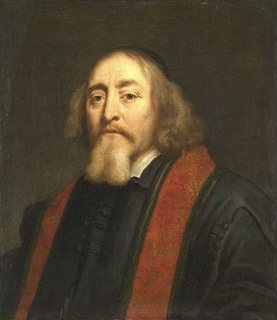
Open Comenius's interactive page (graphs of influences, similar and opposing positions, and quotes)
Background
John Amos Comenius
Born: March 28, 1592 in The Margraviate of
Moravia (now part of the Czech Republic)
Died: November 15, 1670 in Amsterdam
Alma mater: Heidelberg University (1613-1614)
Main interests: Education, theology, religion,
music, organization of all human knowledge
Influences: Francis Bacon, Descartes, J. Bohme,
W. Bathe, Johann Piscator, Heinrich Gutberleth,
Johann Heinrich Alsted, J. V. Andreae, Nicholas
of Cusa, Juan Luis Vives, T. Campanella,
Raymond of Sabunde, Marin Mersenne, Jan Hus
Influenced: Karl von Raumer, Daniel Benham,
Simon Somerville Laurie, Robert Quick, Ossian
Lan, Nicholas Murray Butler, M. W. Keatinge,
John W. Adamson, Ellwood Cubberley, Tomas
Garrigue Masaryk, James B. Conant, R.
Fitzgibbon Young, O. Odlozilik, Cotton Mather
From Wikipedia
Comenius was a Moravian philosopher, peda- gogue and theologian who is considered the father of modern education. He served as the last bishop of the Unity of the Brethren before becoming a religious refugee and one of the earliest champi- ons of universal education, a concept eventually set forth in his book Didactica Magna. As an educator and theologian, he led schools and advised governments across Protestant Europe through the middle of the seventeenth century.
Introductory Comments
Comenius belonged to the Unity of the Brethren, a Czech church descended from the Hussite reform and older than Luther by two generations. That pedigree did him no good once the Habsburgs set about restoring Catholicism to the Czech lands. The Battle of White Mountain in 1620 settled the matter militarily; the decrees that followed settled it legally. In 1621 imperial troops sacked Fulnek, where Comenius was pastor and schoolmaster, and burned his house and his books. He went into hiding for seven years, sheltered by sympathetic nobles, until a new ordinance forced non-Catholics to convert or leave. He crossed into Poland.
The years underground cost him more than his library. In 1622 plague took his wife and both their children. Hunted and bereaved, he wrote The Labyrinth of the World and the Paradise of the Heart, an allegory about a pilgrim who finds every trade and profession a fraud, and finds rest only when he stops looking outward. A man in a hole in the ground had reason to think the world a maze.
Speaking of holes: One escape story seems lifted from a Hollywood film. Soldiers arrive on a tip; Comenius folds himself under the floorboards while the search party tramps overhead, debating where he might be, close enough that he catches every word. Then they leave. Whether it happened this way is anyone's guess, but that his admirers told such stories says something true about the man and the life he was forced to live.
Some of Comenius's Key Positions
Every child should be educated - girls as well as boys, the poor as well as the rich. And education should be a pleasure, not a terror. Schools that flog learning into children are the slaughterhouses of the mind.
Children develop on nature's timetable, moving from simple things to complex ones. Instruction should follow that timetable rather than fight it. Nature makes no leaps, and neither should a teacher. Presenting concepts before students are ready to grasp them wastes everyone's time.
Schools should therefore be graded by age - four stages of six years each: the mother's school at home in infancy, the vernacular school in childhood, the Latin school in adolescence, and finally the university, capped by travel.
Children should be taught first in their native tongue rather than in Latin, and their books should be illustrated. Also, things should come before words. Sense experience and understanding matter far more than rote memorization, and what students learn should connect to the everyday world they actually live in.
On a grander scale, all human knowledge should be gathered, ordered, and published. The aim of this pansophy, or universal wisdom, is not to equip a learned elite but to put knowledge within everyone's reach.
Place in the History of Ideas
Comenius's Place in the History of Ideas
John E. Sadler: During his lifetime the fame of Comenius rested chiefly on his two popular textbooks, the Janua and the Orbis Sensualium Pictus. He himself would have set more store by his influence as a social reformer, which reached its peak during his visit to England. Men all over Europe had looked to Comenius as a leader; his vision had impressed both those who were seeking a more dynamic form of religion and those who looked to science as an avenue of reform. His pansophism [universal education], on the other hand, was not influen-tial either during his lifetime or afterward. His dream of universal harmony was too vague and too grandiose for the mental outlook of the 17th century, which was already shifting in a utilitarian and materialistic direction....
Sevan G. Terzian: Comenius is best known for his innovations in pedagogy, but one cannot gain an adequate appreciation of his education- al ideas without recognizing his religious and metaphysical convictions. Despite the prevalent human suffering of his day, Comenius remained optimistic about the future of mankind, as he believed in the immanence of God and the imminence of God's kingdom on Earth.... Comenius also felt that Christ's Second Coming would end human strife but that people them- selves could act in ushering the new millennium by engaging in... the lifelong study of an encyclopedic system of human knowledge.
Random Thoughts on Comenius
Should education be built from the top down or the ground up? Should young minds be poured into the molds of the established disciplines - English, history, mathematics - or should instruction follow the child's own developing interests? The old answer was top-down and unembarrassed about it. Students came to school to learn what others had discovered. Ignorance out, knowledge in, like water into a glass. One might expect Comenius, who spent his life dreaming of an encyclopedia of everything, to be pourer-in-chief. He was not. He insisted that instruction follow nature's order, which turned out to mean the child's order: simple before complex, things before words, nothing forced on a student before he is ripe for it.
He was not the first to say so. Quintilian had recommended making early study a game fifteen centuries earlier, and Erasmus and Montaigne had both swung at rote learning and the rod. Comenius's originality lies in building a whole system on the principle. More interesting, he never thought he was choosing sides. Nature's order and knowledge's order were to his mind the same order, laid down by the same Author, so a method suited to a child's growth would deliver the encyclopedia in exactly the right sequence. That freed him to be as systematic as he pleased - and he pleased quite a lot, comparing good teaching to the printing press, one master stamping knowledge on a hundred pupils at once.
Influences
Comenius was influenced by: Alsted, J.H., Andreae, J.V., Bacon, Francis, Bathe, W., Bohme, J., Campanella, T., Descartes, Gutberleth, H., Hus, Mersenne, Nicholas of C., Piscator, J., Raymond of S.
Comenius influenced: Adamson, J.W., Benham, D., Butler, N.M., Conant, James, Cubberley, E., Keatinge, M.W., Lan, Ossian, Laurie, S.S., Masaryk, T., Mather, Cotton, Odlozilik, O., Quick, Robert, Raumer, K. von
Similar and opposing positions
Thinkers with similar positions:
- Condorcet (Education is crucial to the emancipation of all individuals.)
- Fuller (As rational creatures, women have a right to a good education.)
- Locke (Education is more than memorization. Children must learn to reason.)
- Montaigne (A liberal education develops a capacity to think deeply & broadly)
- Rousseau (With proper education & government, society will progress greatly.)
- Weber (Cultural, not just economic, forces drive history and shape society.)
- Wollstonecraft (As rational beings, girls must be educated in same way as boys.)
Thinkers with opposing positions:
- Aristotle (Women are more impulsive, deceptive and irrational than men.)
- Dawkins (Religion teaches us to be satisfied with our lack of understanding.)
- Evola (Women are by nature completely subordinate to men & must remain so.)
- Fichte (Active citizenship and civic freedom should be withheld from women.)
- Franklin (The only religion that's at all defensible is pure and simple deism.)
- Holbach (Religion is an impediment to the moral advancement of humanity.)
- Marx (The comfort of religion is illusory & keeps the masses quietly enchained.)
- Sade (To be free means to be unrestrained by any chains of morality.)
- Stirner (All "sacred truths" in law, morality & religion are artificial concepts.)
What others said about Comenius
- Hannah S. Bowers: Comenius is rightly called the father of modern education because of the wealth of reforms he advocated for public education.
- Paul Heidebrecht: Comenius stood firmly within the tradition of Renaissance humanism and of the Protestant Reformation, although he, like many others, was disappointed in some of the fruits of these movements.
- Hans Aarsleff: [Comenius believed] girls and boys must be educated together;... they must be taught in a spontaneous and playful manner.... Failure in learning was not the learner’s fault but evidence of the teacher’s inadequacy to perform his role as the servant of nature, or - as Comenius often said - as the obstetrician of knowledge.
- John E. Sadler: He was no sectarian but a champion of the church universal. He was also, for all of his internationalism, a Czech patriot at a time when the Czechs had been nearly crushed.
- Eve Chybova Bock: For seven years he lived the life of a fugitive in his own land, hiding in deserted huts, in caves, even in hollow trees.
- Sevan G. Terzian: Comenius's belief that knowledge and wisdom could be merged into a single pan-science drew the criticism of... Descartes, who sought to free science from theology in a quest to gain knowledge objectively.
- Wayne R. Rood: For Comenius, schools as he found them were "the slaughterhouse of the mind," devoted as they were to the dreary and sometimes desperately enforced study of Latin in a world where that language was no longer used. In his schools there was to be no "stuffing and flogging," but, rather, a reasonable following of "the lead of nature."
- Gerald L. Gutek: Comenius believed that... enlightened education would end the strife that wracked Europe by bringing about ecumenical and intercultural understanding between peoples of different religions and ethnicities.
Schools: Christian Theology
Main interests: Education, Music, Religion, Theology
Comenius's answers to philosophical questions
Education
Each child deserves a good education so that he or she can lead a better life by obtaining religion, knowledge and virtue.
By showing students the underlying harmony of the universe, people will gradually learn to overcome conflict and war.
Besides learning basic subjects like grammar and math, students should learn useful facts about the world they live in.
Teachers should make education as pleasant an experience as possible. Students should be motivated - not terrorized.
"The proper education of the young does not consist in stuffing their heads with a mass of words, sentences, and ideas…."
Don't underestimate play: "Much can be learned in play that will afterwards be of use when the circumstances demand it."
Textbooks are essential and should be written in the native language of the student. Also, pictures should be included.
Sex and Gender
Being both equally the children of God, both boys and girls deserve a good, liberal and useful education.
Society
"Let us have but one end in view, the welfare of humanity; and let us [transcend our own] language, nationality [&] religion."